No. 28/16/DKom
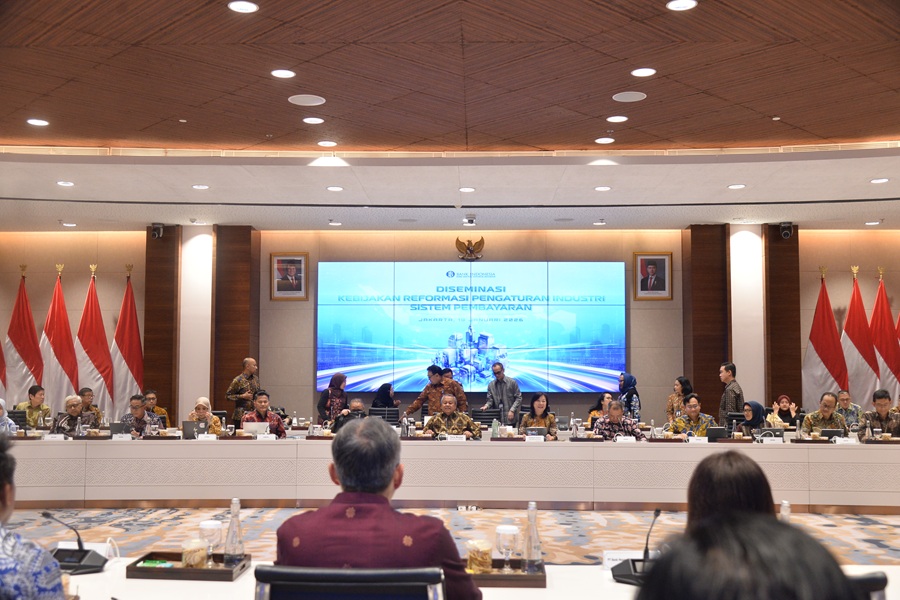
The rapid acceleration of digital payments must be offset by strengthening the structure of the payment system industry towards greater reliability and resilience. To that end, Bank Indonesia is implementing regulatory reform in the payment system industry, which includes application of the TIKMI framework (transactions, interconnection, competence, risk management and information technology infrastructure), as an integral part of Indonesia Payment System Blueprint (BSPI) 2030 implementation. This also demonstrates Bank Indonesia's firm commitment to implementing the mandate of the Financial Sector Development and Strengthening Act (P2SK Act). The statement was conveyed at the Policy Dissemination on Payment System Industry Regulatory Reform, attended by the heads of 203 Payment System Service Providers and Support Providers at Bank Indonesia in Jakarta.
The Governor of Bank Indonesia, Perry Warjiyo, took the opportunity to explain how regulatory reforms to strengthen the payment system industry serve as a foundation for creating and maintaining a consolidated and resilient national payment system industry to safeguard fast, safe and sustainable growth of the digital economy in Indonesia. Various digitalisation initiatives targeting payments, as contained in BSPI 2025, have significantly increased the growth of digital transactions. The volume of digital transactions is expected to reach 147.3 billion transactions by 2030. This is supported by greater use of QRIS, BI-FAST and SNAP, while strengthening the digitalisation of (central and regional) government transactions. On the other hand, the exponential growth of digital transactions has also been accompanied by greater risk complexity, including operational risk and cyber risk. Consequently, efforts to strengthen the structure of the payment system industry must be accompanied by adequate measures to strengthen competencies, risk management and information technology infrastructure by industry players.
As the basis for regulatory reform in the payment system industry, BI issued Bank Indonesia Regulation (PBI) Number 10 of 2025 concerning Payment System Industry Regulation and Board of Governors Regulation (PADG) Number 32 of 2025 concerning Payment System Industry Regulation on 24th December 2025, effective from 31st March 2026.
Speaking at the event, the Deputy Governor of Bank Indonesia, Filianingsih Hendarta, emphasised that regulatory reform is also the concern of industry players because it includes strengthening the overall structure of the industry. The regulatory reform encompasses the use of TIKMI as a reference for assessing PSP performance, classifying PSP, structuring activities, participating in the retail payment system infrastructure, PSP cooperation with third parties, particularly Support Providers, as well as strengthening oversight and monitoring. In addition, the PBI and PADG regulations also serve as a legal umbrella for strengthening payment system infrastructure, including data infrastructure, as well as strengthening institutional arrangements and functional roles in advancing future digital innovation.
The regulatory reform was formulated through empirical testing, involving payment system industry players, to ensure seamless and effective implementation. The reforms will be accompanied by an adequate transition period to ensure the readiness of payment system industry players. Through such policies, Bank Indonesia urges all industry players to continuously enhance their capacity and capabilities, while strengthening synergy to maintain payment system stability and support sustainable economic growth.
Jakarta, 22nd January 2026
Communication Department
Ramdan Denny Prakoso
Executive Director