No. 28/102/DKom
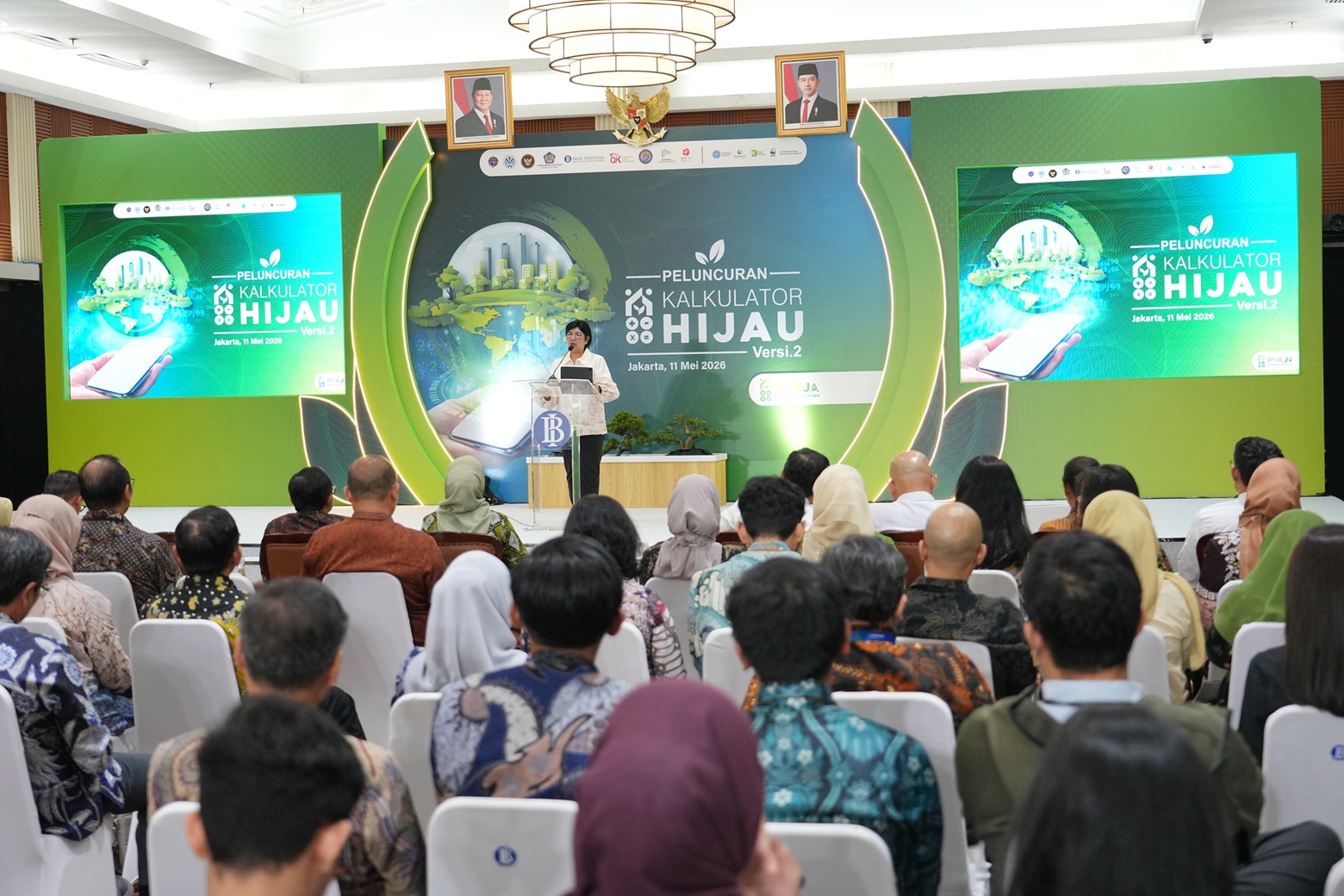
Strengthening sustainable finance is no longer a choice, but rather a strategic necessity to foster economic resilience amid climate change challenges. Such efforts must be supported by credible, standardised, reliable and comparable carbon emissions data. “Version 2 of the Green Calculator is a strategic instrument to enhance consistency and standardisation in carbon emissions calculations," stated Bank Indonesia Senior Deputy Governor, Destry Damayanti, at the launch of Green Calculator Version 2 at Bank Indonesia in Jakarta (12/05/26). This updated version is expected to assist businesses and financial institutions in calculating carbon emissions more accurately and consistently as a basis for sustainability reporting, the development of green finance and climate risk management. The launch ceremony was also attended by representatives from the Ministry of Finance, Financial Services Authority (OJK), Coordinating Ministry for Food Affairs, Indonesian Employers Association (APINDO), as well as banking industry and academics.
Deputy Minister of Finance, Juda Agung, underscored the importance of the Green Calculator as part of the efforts to strengthen sustainable finance. Deputy Minister Juda expects the Green Calculator to not only help fulfil reporting requirements but also be integrated into risk management practices. “We cannot control what we do not measure. The Green Calculator, therefore, is not only a calculation tool, but also an important instrument to help control carbon emissions," he stated. From a fiscal perspective, the Government has orchestrated the State Budget (APBN) to address climate change issues, including through various tax incentives, such as tax allowances, tax holidays, as well as customs and other fiscal facilities, to support green economic development.
From a supervisory perspective, Chief Executive of Banking Supervision at OJK, Dian Ediana Rae, emphasised that climate change could trigger financial risks for the financial sector. As the interlinkages between economic and ecological resilience become stronger, banks are encouraged to measure climate-related risks and integrate them into business strategies and risk management practices. Consequently, strengthening the measurement of carbon emissions has become an essential element of supporting comprehensive risk management.
Sustainable lending continues to maintain positive growth, with room for further expansion. In December 2025, green automotive loans posted 70.08% (yoy) growth, while green housing loans continued to expand in line with growing awareness among businesses, including MSMEs, of financing that supports a low-carbon economy. This was accompanied by maintained loan quality, as reflected by the low non-performing loan (NPL) ratios of green automotive loans and green housing loans at 0.30% and 0.84%, respectively. Bank Indonesia continues to promote green financing through its Macroprudential Liquidity Incentive Policy (KLM) by providing incentives to banks that extend loans/financing to MSMEs, cooperatives, inclusive and sustainable sectors of up to 1% of the Statutory Reserve Requirements (SRR).
Version 2 of the Green Calculator was developed as an improvement of Version 1.0, featuring broader coverage, more comprehensive methodologies and improved user accessibility. This has become increasingly relevant amid growing banking sector efforts to calculate carbon emissions. A survey conducted by Bank Indonesia involving 105 banks in 2025 indicated that most banks calculated emissions independently, with the Green Calculator becoming the most widely used tool. The Green Calculator now produces higher quality emissions data aligned with the international Greenhouse Gas (GHG) Protocol standard. This initiative is also in line with efforts to achieve Indonesia's Second Nationally Determined Contribution 2035 and Net Zero Emission target by 2060. The development process was undertaken by the Green Calculator Working Group, involving Bank Indonesia in conjunction with various authorities, agencies and institutions, including the Ministry of Finance, Financial Services Authority (OJK), Coordinating Ministry for Food Affairs, Coordinating Ministry for Infrastructure and Regional Development, Ministry of Transportation, Ministry of the Environment, National Development Planning Agency (Bappenas), Association of Indonesian Private Commercial Banks (Perbanas), Indonesian Transportation Society, Indonesia Research Institute for Decarbonisation, National Research and Innovation Agency, World Wide Fund (WWF) Indonesia, and the National Greenhouse Gas Methodology Panel Team.
The Green Calculator application can be downloaded free of charge via the App Store and Play Store, complete with user manuals and worksheets accessible through the official Bank Indonesia website.
Jakarta, 11th May 2026
Communication Department
Ramdan Denny Prakoso
Executive Director