No.24/62/DKom
Bank Indonesia Governor, Perry Warjiyo, reiterated the need for joint coordination (recover stronger, recover together) to maintain global economic recovery momentum. Moving forward, Governor Perry emphasised three key measures to welcome a new civilisation in terms of coordinated G20 leadership. First, cooperation in health by providing assistance to countries with inadequate access to vaccines. Second, overcoming the current issues, namely policy normalisation in advanced economies, to recover together. And third, achieving stronger growth together by addressing future issues that are beginning to emerge, such as productivity, digitalisation and the environment. That was the key takeaway of the high-level discussion, Policy Normalisation and Global Growth Momentum (19/02), as part of the side events of the 2nd Finance and Central Bank Deputies Meeting (FCBD) and 1st Finance Ministers and Central Bank Governors Meeting (FMCBG) of Indonesia's G20 Presidency, held 14-19th February 2022 in Jakarta.
The importance of an optimal policy approach to normalisation and the scarring effect, which continue to loom over the global economy, was raised at the discussion. The policy response must narrow the productivity gap by enhancing workforce skills and competencies, support the expansion of intangible assets in digital transformation and unlock access to dynamic markets, such as digital-based industries.
The discussion also addressed the challenges of achieving and maintaining financial system stability, including digitalisation and climate change. In terms of digitalisation, the challenges include inclusive finance and the development of digital currencies. The financial sector plays an essential role in sustaining recovery momentum by absorbing shocks, facilitating the transition towards a green economy, enhancing productivity through new payment methods and disbursing inclusive finance.
Furthermore, financial intermediation, financial technology innovation and climate change issues are the three salient aspects of recovery. Lessons learnt from the 2008 crisis and Covid-19 pandemic have reinforced the importance of strengthening financial system resilience. Both shocks provided greater understanding concerning the significance of market liquidity to support the intermediation function. Financial system integration is increasing, with international organisations such as the Financial Stability Board (FSB) functioning to analyse the financial system holistically for existing vulnerabilities, including climate change risk. Furthermore, we need to anticipate the financial sector challenges, including the risks associated with normalisation, the scarring effect and excessive risk-taking that demands vigilance.
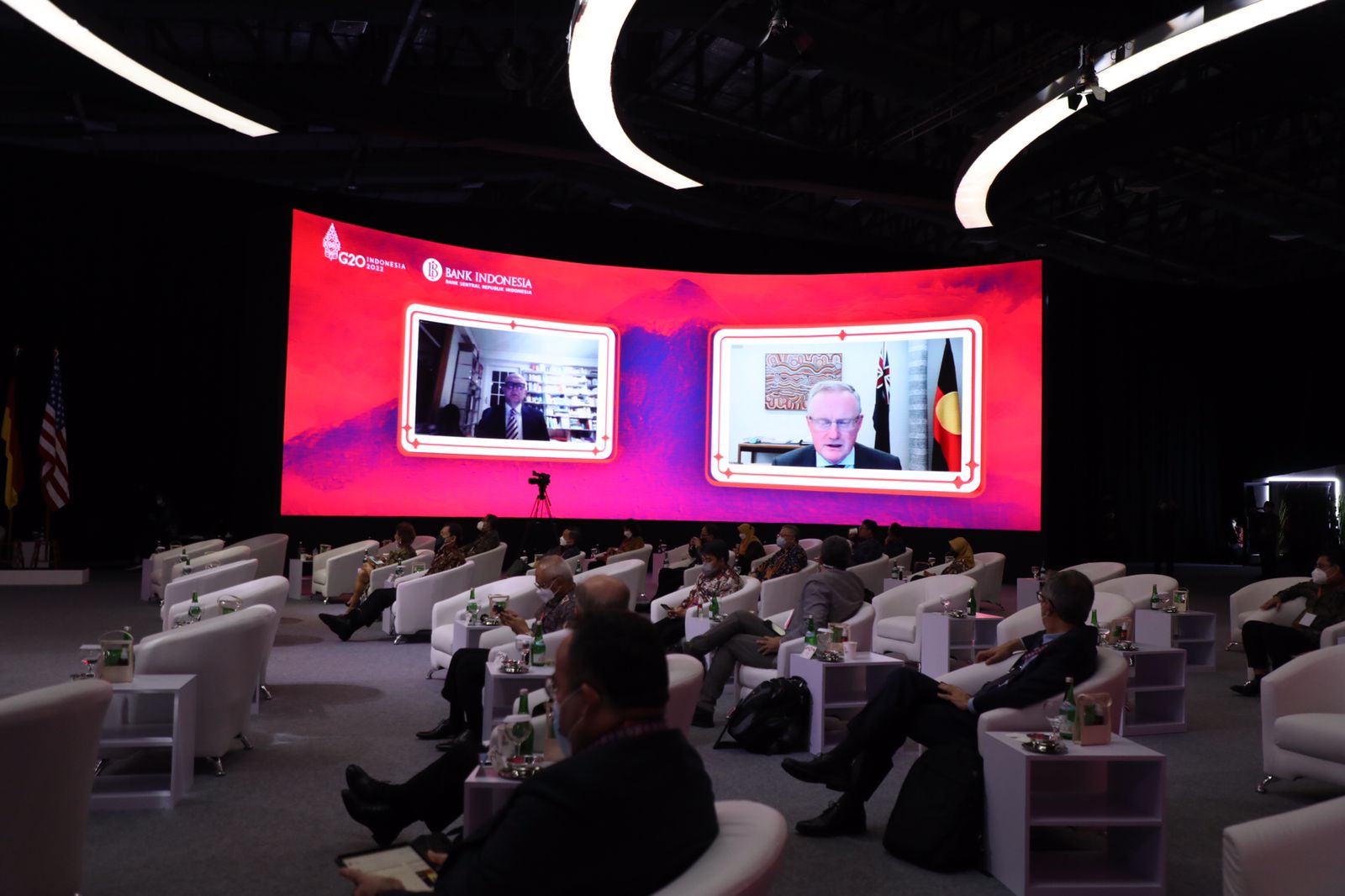
The high-level discussion was officially opened by the Deputy Governor of Bank Indonesia, Dodi Budi Waluyo, who took the opportunity to stress the importance of each country overcoming the pandemic for a positive impact on the real and financial sectors towards recovery and global financial system stability. The second session of the event, entitled Global Financial Stability and Its New Challenges, was moderated by the Senior Deputy Governor of the Bank of Italy, Luigi F. Signorini, featuring discussions with the Deputy Governor of Bank Indonesia, Juda Agung, Governor of the Reserve Bank of Australia, Philip Lowe, Secretary General of the Financial Stability Board (FSB), Dietrcih Domansk, and Secretary General of the Organisation for Economic Co-operation and Development (OECD), Marthias Comann.
Jakarta, 19th February 2022
Head of Communication Department
Erwin Haryono
Executive Director
Information about Bank Indonesia
Tel. 021-131, Email: bicara@bi.go.id