No: 28/73/DKom
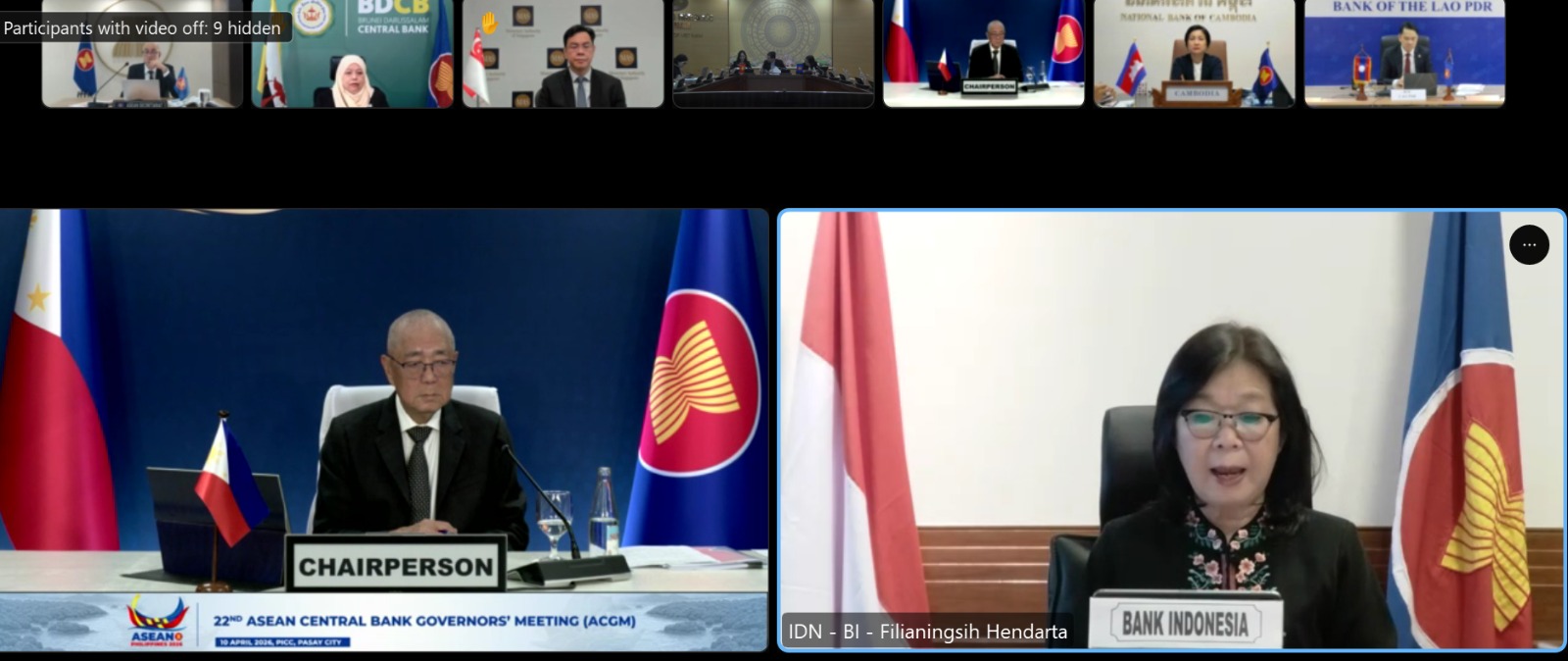
ASEAN continues strengthening policy measures and cooperation to maintain stability and foster regional economic growth amid global dynamics. This is reflected by the robust ASEAN economy, supported by sustained domestic demand and investment, despite facing various global headwinds, including geopolitical tensions, volatile capital flows and climate change challenges. That was highlighted at the 13th ASEAN Finance Ministers' and Central Bank Governors' Meeting (AFMGM), held on 10th April 2026. Representing the Governor of Bank Indonesia, Deputy Governor Filianingsih Hendarta attended the meeting.
At the AFMGM meeting, policymakers from the region reaffirmed their readiness to take the policy measures necessary, while strengthening cooperation with strategic partners to maintain stability in pursuit of sustainable growth. To that end, several strategic measures were agreed to enhance the effectiveness of regional financial cooperation by strengthening financial markets, accelerating cross‑border payment system connectivity and improving the financial health of the public.
As a concrete step towards strengthening cooperation, ASEAN has prepared the Finance Sectoral Plan 2026–2030 as a reference towards the ASEAN Community Vision 2045, as well as implementing the Project Revive initiative to improve the governance, structure and processes of financial sector cooperation.
“The success of Project Revive depends on the firm commitment of all ASEAN members, including ensuring that the new cooperation framework can serve as an effective forum for discussing strategic issues, such as the macroeconomy, financial system stability and regional risks," stated Filianingsih.
The meeting also agreed three Priority Economic Deliverables (PEDs) within the finance and central bank tracks during the Philippines' Chairmanship in 2026, namely strengthening sustainable and resilient capital markets, accelerating regional payment connectivity and bolstering financial health as a new dimension of financial inclusion. These initiatives are expected to spur more inclusive economic growth, broaden access to finance and enhance the welfare and prosperity of people in the region.
In the context of financial integration, ASEAN recorded various positive achievements, including refinements to the ASEAN Banking Integration Framework (ABIF) through the Guidelines 2.0, while strengthening the Capital Account Liberalisation (CAL) framework and expanding the implementation of Local Currency Transactions (LCT). ASEAN also welcomed the new ASEAN Swap Arrangement (ASA) as part of strengthening the regional financial safety net, thus safeguarding economic and financial stability. Such strengthening efforts aim to reinforce external resilience, promote financial integration and support adequate international reserves to maintain financial market stability.
In terms of payment systems, cross‑border connectivity continues to increase and plays a significant role in accelerating financial inclusion, alongside stronger cooperation to protect systems from fraud and scam risks. On the sustainable finance agenda, ASEAN is promoting the mobilisation of public and private funding, increasing access to climate finance and providing capacity building for member states to support an orderly transition towards a low‑carbon economy.
The 13th AFMGM was co‑chaired by the Philippine Secretary of Finance, H.E. Frederick D. Go, and the Governor of Bangko Sentral ng Pilipinas, H.E. Eli M. Remolona, Jr., and attended by 11 ASEAN member states. Singapore, as ASEAN Chair in 2027, closed the meeting by detailing plans to hold the 14th AFMGM in 2027.
Jakarta, 13th April 2026
Communication Department
Ramdan Denny Prakoso
Executive Director
[1] The AFMGM is an annual meeting of Central Bank Governors and Finance
Ministers of ASEAN member states, aimed at discussing global and regional
economic developments, policy challenges in the region, as well as economic and
financial cooperation initiatives. The meeting is attended by representatives
from all ASEAN member states.