No. 28/127/DKom
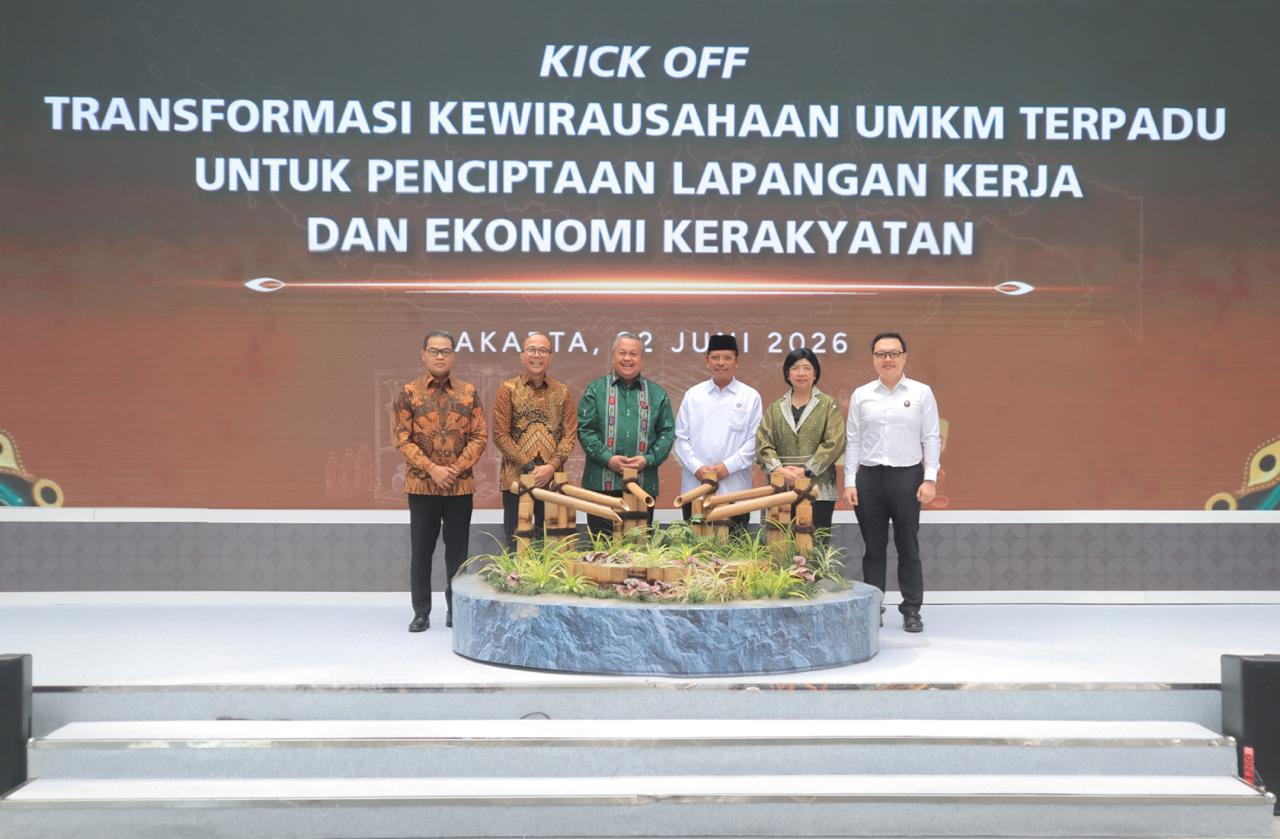
Micro, small and medium enterprises (MSMEs) are the foundation of job creation and a future generation of productive and competitive entrepreneurs. Amid increasing global economic uncertainty, strengthening MSMEs supports domestic economic growth while improving public welfare. Moreover, strengthening MSMEs is also in line with national priority programs and implementation of the Government's Asta Cita to strengthen the local economy. That was the key takeaway delivered by Bank Indonesia Governor, Perry Warjiyo, during his remarks at the launch of the Integrated MSME Entrepreneurship Transformation Program for Job Creation and the Local Economy in Jakarta (22/06/26). The event was attended by the Minister of Religious Affairs, Nasaruddin Umar, as well as senior officials from the Coordinating Ministry for Community Empowerment, Ministry of MSMEs, banking industry leaders, associations, Islamic boarding schools (pesantren) and MSME entrepreneurs.
The strategic role of MSMEs is reflected in their contribution to the national economy. Data from the Ministry of Cooperatives and SMEs (2024) shows that MSMEs contribute 60.5% to Gross Domestic Product (GDP), absorb 90% of labour and account for 15% of Indonesia's exports. “Increasing global economic uncertainty demands economic self-reliance in Indonesia through the creation of new entrepreneurs and capacity building for MSMEs. Ensuring a greater impact, the best business models have been selected from MSMEs under the mentorship of Bank Indonesia, thereby making certain that the business models have been proven in practice," Governor Perry stated. Governor Perry also emphasised that the Integrated MSME Entrepreneurship Transformation Program is designed to generate a tangible impact through the creation of entrepreneurs capable of creating added value, unlocking employment opportunities and strengthening the local economy. The program is implemented nationally leveraging the network of 46 Bank Indonesia Representative Offices in synergy with government ministries/agencies, strategic stakeholders, more than 3,000 BI-assisted MSMEs and more than 1,500 empowered pesantren. According to Governor Perry, entrepreneurial capabilities are key to MSME advancement, built through entrepreneurial education, evaluation and the implementation of proven business models. “Strong motivation, perseverance and the ability to build cooperation are important foundations for MSME betterment and advancement," Governor Perry concluded.
The Minister of Religious Affairs, Nasaruddin Umar, took the opportunity to express utmost appreciation for the synergy that has been established between Bank Indonesia, the Government and various stakeholders in developing the Islamic economy and finance, including pesantren empowerment. According to Minister Nasaruddin, strengthening the pesantren economy is an important part of building the economic self-reliance of the community (ummah) and broadening the benefits of the sharia economy for the community. “Through strong and sustainable synergy, we hope that the Islamic economy, particularly the pesantren-based economy, will continue to develop and bring broader blessings to society and the national economy," he stated.
Four flagship programs form part of the Integrated MSME Entrepreneurship Transformation in 2026 as follows:
- Cangkir Barista
This program aims to enhance the competitiveness across the coffee value chain, from upstream to downstream, through the facilitation of international certification for 400 baristas, coupled with business assistance to open coffee shop businesses. The baristas are expected to develop a coffee ecosystem with linkages to domestic coffee farmers and overseas coffee importers.
- Citra Nusa
This program aims to strengthen Indonesian MSMEs specialising in traditional textiles in export markets and to absorb more labour. Technical capacity building, entrepreneurial capacity building and product design innovation for 300 MSMEs are expected to unlock various compelling opportunities to penetrate global markets.
- Air Berkah Indonesia
This program encourages economic self-reliance among pesantren through the development of bottled drinking water businesses based on local resources. The program is targeting 200 pesantren in 2026.
- Tani Berkah Indonesia
Using greenhouse technology, the Tani Berkah Indonesia program is expected to boost the production and economic value of agricultural products from pesantren, increase labour absorption and, ultimately, safeguard food resilience regionally. The program targets 10 pesantren annually.
The Integrated MSME Entrepreneurship Transformation Program is aligned with the direction of the National Medium-Term Development Plan (RPJMN) 2025-2029 in terms of strengthening the local economy by increasing MSME competitiveness, expanding access to the economy and finance, and creating employment opportunities. The program is designed comprehensively end to end, from strengthening entrepreneurial capacity, business assistance, product innovation and access to financing to export market expansion, in order to create a new generation of productive and competitive entrepreneurs.
In synergy with the Government and all stakeholders, Bank Indonesia is committed to strengthening a productive, innovative and competitive national entrepreneurship ecosystem. Through this strategic synergy, the people's economy in Indonesia is expected to become stronger, more inclusive and sustainable towards the vision of Golden Indonesia 2045.
Jakarta, 22nd June 2026
Communication Department
Ramdan Denny Prakoso
Executive Director