No. 23/144/DKom
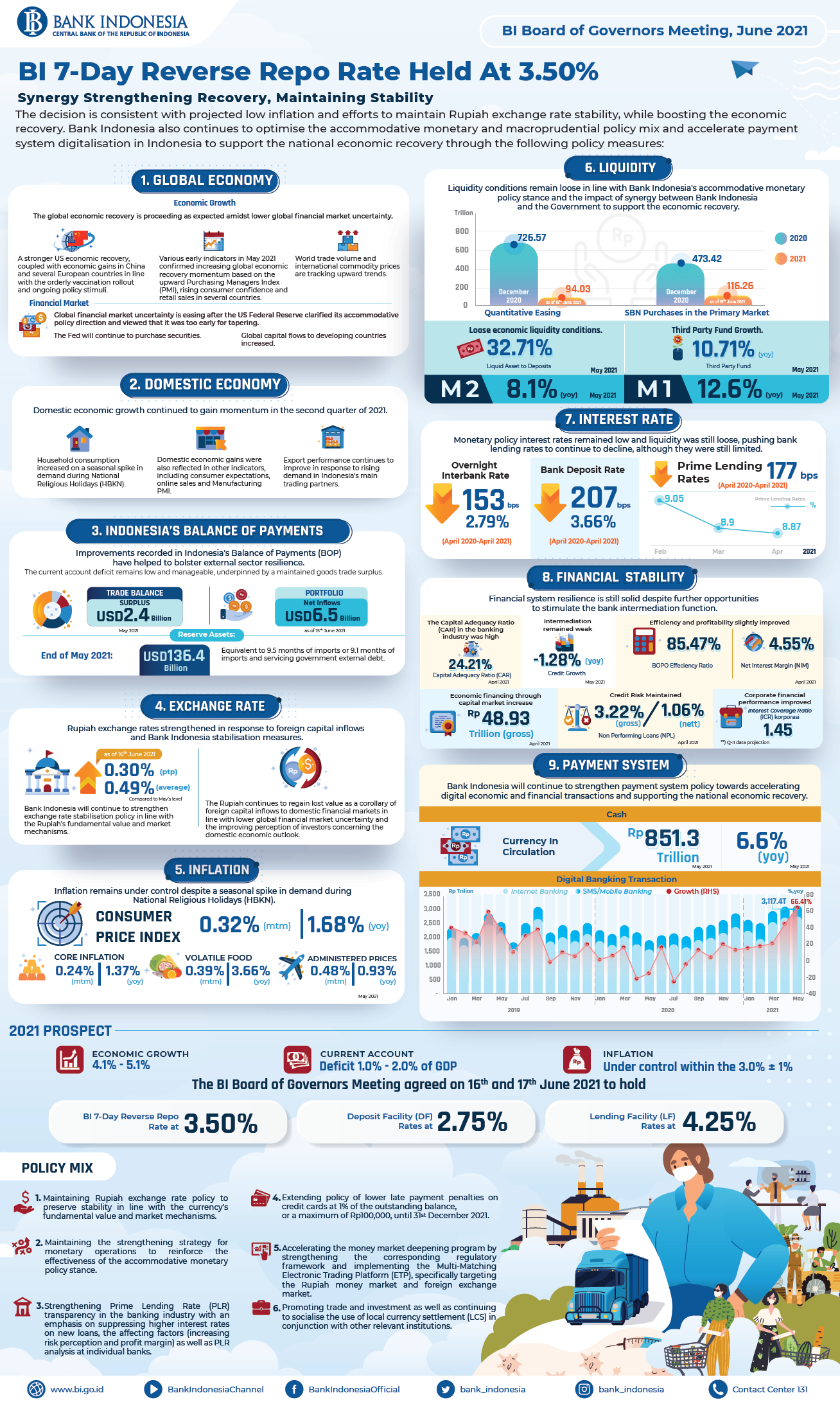
The BI Board of Governors Meeting agreed on 16th and 17th June 2021 to hold the BI 7-Day Reverse Repo Rate at 3.50%, while also maintaining the Deposit Facility (DF) rates at 2.75% and Lending Facility (LF) rates at 4.25%. The decision is consistent with projected low inflation and efforts to maintain Rupiah exchange rate stability, while boosting the economic recovery. Bank Indonesia also continues to optimise the accommodative monetary and macroprudential policy mix and accelerate payment system digitalisation in Indonesia to support the national economic recovery through the following policy measures:
- Maintaining Rupiah exchange rate policy to preserve stability in line with the currency's fundamental value and market mechanisms.
- Maintaining the strengthening strategy for monetary operations to reinforce the effectiveness of the accommodative monetary policy stance.
- Strengthening Prime Lending Rate (PLR) transparency in the banking industry with an emphasis on suppressing higher interest rates on new loans, the affecting factors (increasing risk perception and profit margin) as well as PLR analysis at individual banks (Appendix).
- Extending policy of lower late payment penalties on credit cards at 1% of the outstanding balance, or a maximum of Rp100,000, until 31st December 2021, to encourage the use of credit cards as a private consumption buffer to support the national economic recovery.
- Accelerating the money market deepening program by strengthening the corresponding regulatory framework and implementing the Multi-Matching Electronic Trading Platform (ETP), specifically targeting the Rupiah money market and foreign exchange market.
- Promoting trade and investment as well as continuing to socialise the use of local currency settlement (LCS) in conjunction with other relevant institutions. In June and July 2021, Bank Indonesia will promote trade and investment in Japan, United States, Mexico, France, Sweden, Norway, Singapore, Australia and China.
In response to the latest global and domestic economic dynamics, Bank Indonesia continues to strengthen policy synergy with the Government and Financial System Stability Committee, including implementation of the Integrated Policy Package to accelerate the national economic recovery. Bank Indonesia is also coordinating with the Government and other relevant authorities to: (i) bring down lending rates in the banking industry, (ii) stimulate loans/financing disbursed to businesses and priority sectors, and (iii) carefully monitor Covid-19 transmission dynamics and the economic impact on Indonesia.
The global economic recovery is proceeding as expected amidst lower global financial market uncertainty. Such developments are attributable to a stronger US economic recovery, coupled with economic gains in China and several European countries in line with the orderly vaccination rollout and ongoing policy stimuli. Meanwhile, India's economy is expected to continue moderating as mobility restrictions are expanded to break the surge of Covid-19 cases. Various early indicators in May 2021 confirmed increasing global economic recovery momentum based on the upward Purchasing Managers Index (PMI), rising consumer confidence and retail sales in several countries. In addition, world trade volume and international commodity prices are tracking upward trends. On the other hand, global financial market uncertainty is easing after the US Federal Reserve clarified its accommodative policy direction and viewed that it was too early for tapering. The Fed will continue to purchase securities until substantial developments in terms of inflation and employment are observed. The positive tone pushed global capital flows to developing economies, including Indonesia, and led to local currency appreciation.
Domestic economic growth continued to gain momentum in the second quarter of 2021, as signalled by improvements in several early indicators in May 2021. Household consumption increased on a seasonal spike in demand during National Religious Holidays (HBKN), as revealed in retail sales, food, beverages and tobacco in particular, as well as automotive fuel. Domestic economic gains were also reflected in other indicators, including consumer expectations, online sales and Manufacturing PMI. From an external perspective, export performance continues to improve on the back of coal, iron and steel as well as motor vehicle shipments in response to rising demand in Indonesia's main trading partners. Spatially, all Indonesian regions recorded strong export performance in the reporting period, led by Java, Kalimantan and Sulawesi-Maluku-Papua (Sulampua). Economic gains were also reflected in several major sectors, including the Manufacturing Industry, Trade and Construction. Moving forward, a stronger global economy, faster vaccination rollout and closer policy synergy will drive the domestic economic recovery despite the recent uptick in Covid-19 cases reported at the end of the second quarter. Consequently, economic growth in 2021 remains in line with Bank Indonesia's April 2021 projection of 4.1-5.1%.
Improvements recorded in Indonesia's Balance of Payments (BOP) have helped to bolster external sector resilience. The current account deficit remains low and manageable, underpinned by a maintained goods trade surplus. The trade balance in May 2021 recorded a USD2.4 billion surplus, up slightly from USD2.3 billion one month earlier, influenced by positive performance across most major commodities amidst persistently strong imports to meet domestic demand as the economy recovers. Meanwhile, foreign capital inflows to Indonesia were maintained, with portfolio investment recording a USD6.5 billion net inflow in the period from April until 15th June 2021, given lower global financial market uncertainty. The position of reserve assets at the end of May 2021 remained high at USD136.4 billion, equivalent to 9.5 months of imports or 9.1 months of imports and servicing government external debt, which is well above the 3-month international adequacy standard. Moving forward, Bank Indonesia projects a low and manageable current account deficit in 2021 at approximately 1.0-2.0% of GDP.
Rupiah exchange rates strengthened in response to foreign capital inflows and Bank Indonesia stabilisation measures. As of 16th June 2021, the Rupiah appreciated 0.49% on average and 0.30% (ptp) on the May 2021 level. The Rupiah continues to regain lost value as a corollary of foreign capital inflows to domestic financial markets in line with lower global financial market uncertainty and the improving perception of investors concerning the domestic economic outlook. As of 16th June 2021, therefore, the Rupiah recorded 1.32% (ytd) depreciation on the level recorded at the end of 2020, which is comparatively lower than currencies in neighbouring countries, including Thailand, South Korea and Malaysia. Moving forward, Bank Indonesia will continue to strengthen exchange rate stabilisation policy in line with the Rupiah's fundamental value and market mechanisms through effective monetary operations and adequate market liquidity.
Inflation remains under control despite a seasonal spike in demand during National Religious Holidays (HBKN). In May 2021, the Consumer Price Index (CPI), as a measure of headline inflation, stood at 0.32% (mtm), increasing from 0.13% (mtm) in April 2021. Therefore, consumer price inflation exceeded the corresponding seasonal average in 2020 (0.07% mtm) but was below the historical average of the past five years (0.52% mtm). Annually, headline inflation was recorded at 1.68% (yoy), up from 1.42% (yoy) in the previous period. Recent inflation developments have been influenced by higher core inflation, edged upwards by growing demand, amidst maintained exchange rate stability and consistent Bank Indonesia policies to anchor inflation expectations to the target corridor. Volatile food inflation also increased on seasonal demand. Meanwhile, inflationary pressures on administered prices remain under control despite higher airfares. Moving forward, Bank Indonesia remains firmly committed to maintaining price stability and strengthening policy coordination with the central and regional governments through national and regional inflation control teams (TPI and TPID) to control headline inflation within the predetermined target range, namely 3.0%±1% in 2021.
Liquidity conditions remain loose in line with Bank Indonesia's accommodative monetary policy stance and the impact of synergy between Bank Indonesia and the Government to support the economic recovery. Bank Indonesia has injected liquidity through quantitative easing to the banking industry totalling Rp94.03 trillion in 2021 (as of 15th June 2021). Furthermore, Bank Indonesia continues to purchase SBN in the primary market as part of policy synergy between Bank Indonesia and the Government to fund the 2021 State Revenue and Expenditure Budget (APBN). As of 15th June 2021, Bank Indonesia has purchased SBN in the primary market totalling Rp116.26 trillion, consisting of Rp40.80 trillion through primary auction and Rp75.46 trillion through Greenshoe Options (GSO). Expansive monetary policy supports loose economic liquidity conditions, as reflected in the high ratio of liquid assets to deposits at 32.71% and deposit growth of 10.71% (yoy). Liquidity in the economy has also increased, as indicated by narrow (M1) and broad (M2) money supply, which grew 12.6% (yoy) and 8.1% (yoy) in May 2021. Nevertheless, loose liquidity conditions have not optimally fed through to drive economic growth amidst a lower velocity of money in the economy in line with compressed domestic demand.
A low policy rate and loose liquidity conditions in the banking industry have precipitated lower lending rates despite ongoing rigidity. In the markets, the overnight interbank rate and deposit rate fell by 153bps and 207bps since April 2020 to 2.79% and 3.66% respectively in April 2021. Prime lending rates in the banking industry continue to fall despite rigidity, decreasing just 177bps since April 2020 to 8.87% in April 2021. Despite a lower cost of loanable funds (CoLF), prime lending rates remain rigid given higher profit margins, particularly at national private commercial banks. In addition, an upward trending risk premium points to the high-risk perception of the banking industry concerning the corporate sector. Therefore, lending rates on new loans in April 2020 increased, particularly at regional government banks, state-owned banks and national private commercial banks. Bank Indonesia expects the banking industry to continue lowering lending rates as part of the shared responsibility to stimulate lending to the corporate sector.
Financial system resilience is still solid despite further opportunities to stimulate the bank intermediation function. The Capital Adequacy Ratio (CAR) in the banking industry was high in April 2021 at 24.21%, accompanied by persistently low NPL ratios of 3.22% (gross) and 1.06% (nett). Despite loose liquidity conditions, the bank intermediation function recorded an albeit shallower 1.28% (yoy) contraction in May 2021, driven by strong demand for loans as corporate activity continues to recover in line with increasing sales, tax payable and corporate repayment capacity. In the household sector, demand for property continues to strengthen, with growth of housing loans accelerating to 6.61% (yoy) in response to looser LTV policy and tax incentives by the Government. Credit growth is also recovering in the SME sector, trade in particular. Various strengthening measures continue to be taken through synergy between the authorities, banking industry and corporate sector to build bank intermediation function recovery momentum, maintain optimism and overcome supply and demand-side lending constraints from the banking industry to businesses. To that end, Bank Indonesia will continue to strengthen PLR transparency in the banking industry, while coordinating with the Government and other relevant authorities to nurture lending to the corporate sector and other priority sectors.
Bank Indonesia will continue to strengthen payment system policy towards accelerating digital economic and financial transactions and supporting the national economic recovery. Growth of digital economic and financial transactions is accelerating along with greater public acceptance and growing public preference towards online shopping as well as the expansion of digital payments and digital banking. Therefore, the value of electronic money transactions in May 2021 stood at Rp23.7 trillion, growing 57.38% (yoy). Similarly, the volume and value of digital banking transactions also increased rapidly in May 2021 by 56.49% (yoy) and 66.41% (yoy) to reach 601.2 million transactions and Rp3,117.4 trillion respectively. The transaction value of card-based payment instruments, namely ATM/debit cards and credit cards, grew 21.03% (yoy) in May 2021 to a total of Rp689.7 trillion as economic activity and public demand increased during the approach to Eid-ul-Fitr 1442 H. Bank Indonesia continues to strengthen payment system policy and support development of an inclusive and efficient digital economic and financial ecosystem by accelerating transactions and expanding QRIS merchants in synergy with relevant government ministries/agencies, associations and industries. Furthermore, Bank Indonesia is also strengthening and expanding QRIS socialisation and education activities on the supply and demand sides. In synergy with the Government, Bank Indonesia is expanding the electronification of social aid program (bansos) disbursements and regional government financial transactions, while supporting the National BBI Movement promoting pride in Indonesian-made products (GBBI). Meanwhile, currency in circulation in May 2021 totalled Rp851.3 trillion, up 6.6% (yoy) on growing demand for currency during Eid-ul-Fitr 1442 H. Therefore, Bank Indonesia promotes the efficient distribution of currency in circulation in remote, frontier and disadvantaged (3T) regions, while strengthening cash services, to maintain the availability of quality Rupiah currency and premium cash services throughout Indonesia.
Jakarta, 17th June 2021
Head of Communication Department
Erwin Haryono
Executive Director
Information about Bank Indonesia
Tel. 021-131, Email: bicara@bi.go.id