The Macroprudential
Intermediation Ratio (MIR) and Sharia
Macroprudential Intermediation Ratio (Sharia MIR)
are macroprudential instruments that aim to reduce
the build-up of systemic risk through management of
the bank intermediation function in accordance with
the economic growth target and capacity, while
maintaining prudential principles. These
macroprudential policy instruments are
countercyclical and can be adjusted to changes in
economic and financial conditions. The
Macroprudential Intermediation Ratio (MIR) is almost
similar to loan to deposit ratio but with a broader
coverage of financing component that includes
securities held by banks and accommodate securities
issued and loans received by banks into the funding
component. Consequently, MIR can be more accurately
reflect bank intermediation capabilities.
MIR and Sharia MIR
are calculated based on the following formula:
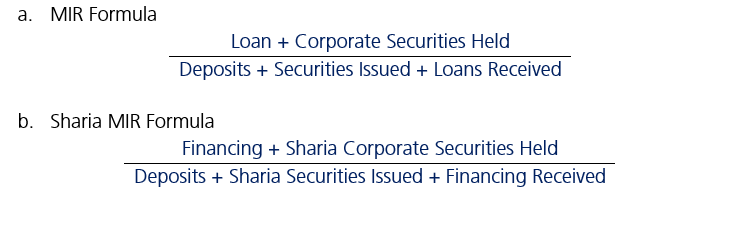
The MIR/Sharia MIR
Giro is the balance of Rupiah demand deposits that
must be maintained at Bank Indonesia by Conventional
Commercial Banks and Sharia Business Units, as well
as Sharia Commercial Banks to fulfil the MIR/Sharia
MIR as follows:
- If the MIR/Sharia MIR is within the target
range, the MIR Giro is set at 0% (zero percent)
of bank deposits denominated in Rupiah.
- If the MIR/Sharia MIR < the MIR target range:
MIR/Sharia MIR Giro = Lower Disincentive
Parameter x (lower limit of MIR/Sharia MIR
target - MIR/Sharia MIR) x bank deposits
denominated in Rupiah
- If the MIR/Sharia MIR > the MIR target range:
MIR/Sharia MIR Giro =
Upper Disincentive Parameter x (MIR/Sharia MIR –
upper limit of MIR/Sharia MIR target) x bank
deposits denominated in Rupiah
Notes:
a.
Upper Disincentive Parameter
b.
Lower Disincentive Parameter
Policy tightening by
reducing the upper limit of the intermediation ratio
or raising the upper disincentive parameter aims to
prevent excessive risk-taking behaviour from
excessive credit growth during an economic
expansionary period. In contrast, accommodative
policy by increasing the minimum intermediation
ratio or raising the lower disincentive parameter
aims to stimulate loan disbursements during an
economic contractionary period.
Seeking to nurture
lending/financing growth to support sustainable
economic growth, while maintaining financial system
stability, MIR/Sharia MIR policy is currently set in
the 84-94% range, with disincentives in the form of
mandatory MIR/Sharia Giro balances held by banks
failing to meet the MIR/Sharia MIR target range.
Latest Regulations concerning MIR/Sharia
MIR
As a financial sector authority, Bank Indonesia
maintains financial system stability, which includes
disbursing funds through its function as lender of
last resort (LoLR) in the form of short-term
liquidity assistance (PLJP) to conventional
commercial banks and sharia-compliant short-term
liquidity assistance (PLJPS) to sharia commercial
banks experiencing a liquidity mismatch.
In this case, a liquidity mismatch is defined as a
short-term liquidity mismatch caused by a smaller
inflow than outflow of funds, thereby preventing a
commercial bank from meeting its reserve
requirements. Bank Indonesia can disburse PLJP/PLJPS
funds for up to 30 calendar days in each period,
which can be extended for a maximum of 2 consecutive
periods (up to a maximum of 90 calendar days
overall).
Latest Regulations concerning PLJP
Latest Regulations concerning PLJPS
The Net Open Position instrument aims to control
currency risk and overcome excessive currency
mismatch, thereby maintaining liquidity resilience
in the banking industry. NOP instrument limits the
gap between the assets and liabilities denominated
in a foreign currency held by a bank, thus reducing
the risks attributable to exchange rate volatility.
In addition, NOP regulations foster greater prudence
in the banking industry in terms of transacting in
foreign currencies, while also avoiding speculative
transactions.
NOP in Rupiah is calculated based on the following
formula:
NOP* = |(∆ foreign currency assets and
liabilities on the balance sheet) + (∆ foreign
currency claims and liabilities in the
administrative account)|
This policy requires banks to manage and maintain an
overall NOP at the end of the business day up to a
maximum of 20% of capital (based
on the closing rate). With this regulation, the
potential losses that could arise from exchange rate
movements are expected to be absorbed by bank
capital, thus avoiding a major impact on banking
activity.
NOP was first regulated in 1989 with the aim of
creating a healthy banking climate. The latest NOP
regulations began with the promulgation of Bank
Indonesia Regulation (PBI) No. 5/13/PBI/2003
concerning the Net Open Position of Commercial Banks
in 2003, which has since been amended 4 (four) times
in 2004, 2005, 2010 and 2015.
Latest Regulations concerning Net Open
Position (NOP)
In its capacity as a
financial intermediary institution, a bank utilises
foreign debt and other bank liabilities in a foreign
currency as a source of short-term foreign funding
that can be used to optimise lending/financing
activity. The Bank Foreign Funding Ratio (RPLN) is
an innovative countercyclical macroprudential policy
instrument to strengthen short-term foreign funding
for banks in accordance with economic needs. RPLN
regulates the maximum ratio of a bank's short-term
liabilities to its capital. In terms of RPLN,
short-term liabilities consist of short-term foreign
debt, short-term debt securities in a foreign
currency, and/or short-term risk participation
transaction.
There are two salient
features of RPLN policy as follows:
- Countercyclical: The RPLN ratio is dynamic
through the determination of the countercyclical
parameter that is evaluated periodically based
on the financial cycle and aggregate growth of
external debt in the banking industry.
- Risk-based approach: The application of a
countercyclical parameter considers external
risks and financial system stability, including
the application of prudential principles that
cover capital capacity, credit risk and market
risk.
With this mechanism,
RPLN is expected to optimise the management of
foreign funding in the banking industry without
increasing risk factors in Indonesia's banking
system.
RPLN is the ratio of
short-term liabilities to capital calculated on a
daily basis.
RPLN formula:

Bank Indonesia has
set the RPLN ratio at a maximum of 30%, accompanied
by an increase or decrease in the percentage of the
countercyclical parameter. The countercyclical
parameter is a percentage that can increase or
decrease the RPLN ratio by positive 5%, 0% or
negative 5%. Currently, the countercyclical
parameter is set at 0%, with the RPLN ratio,
therefore, remaining at
30%.
In addition, banks
with short-term liabilities must apply prudential
principles in the form of fulfilling the following
indicators set by Bank Indonesia:
- capital capacity by fulfilling the Minimum
Capital Adequacy Requirement in accordance with
the risk profile of the bank,
- credit risk by maintaining the gross NPL/NPF
ratio below the 5% threshold, and
- market risk by maintaining a net foreign
exchange position in accordance with bank
Indonesia regulations concerning the net open
position (NOP).
Latest Regulations concerning RPLN


