QR Code Indonesian Standard (QRIS)
Definition

In general, QR Code is a type of two-dimensional barcode made up of three
black squares arranged in a square grid around the bottom left, top left and
top right corners of the barcode, and a module consisting of pixels, which
can store alphanumeric data, characters and symbols, used to facilitate
contactless payment transactions through scanning technology.
The Quick Response Code Indonesian Standard, usually abbreviated to QRIS, is
a standardised QR Code that Bank Indonesia has approved for payments in
Indonesia.
The salient difference between QRIS and the QR codes currently used by the
industry is that all payment transactions can be facilitated by one QR code,
namely QRIS, even when using different payment instruments. This is possible
because each application of the respective payment instrument Issuer can
scan and read QRIS in the QR code at any participating merchant.

Usage Models
QRIS accommodates two QR code usage models, namely Merchant Presented Mode
(MPM) and Customer Presented Mode (CPM). Nevertheless, the models are
implemented in reference to the QRIS standards set by Bank Indonesia as the
national standard.
Parties Processing QRIS Transactions
In terms of processing QRIS transactions, the parties involved include
Payment System Service Providers, Switching Institutions, Merchants,
Aggregators and Managers of the National Merchant Repository. Front-end
payment system service providers, such as issuers and/or acquirers can also
process QRIS transactions.
Payment system service providers and switching institutions engaged in
processing QRIS transactions are required to first obtain approval from Bank
Indonesia.
Funding Sources of QRIS Transactions
QRIS transactions use funding sources in the form of deposits and/or payment
instruments such as debit cards, credit cards and/or server-based electronic
money. The use of funding sources and/or payment instruments is based on a
proposal submitted by a Standard Setting Institution approved by Bank
Indonesia.
Value of QRIS Transactions
QRIS transactions are restricted to a maximum value of Rp10 million per
transaction. Furthermore, Issuers can enforce daily and/or monthly
cumulative limits on QRIS transactions by user based on the risk management
of the Issuer.
QRIS Regulations
The main regulation concerning QRIS implementation is Board of Governors
Regulation (PADG) No. 21/18/PADG/2019 concerning National Implementation
Standards of Quick Response Code for Payments. In addition, for specific
provisions concerning which payment instruments can be used in QRIS
transactions, Bank Indonesia also issued a regulation concerning card-based
payment instruments and electronic money. In relation to the processing of
QRIS transactions, refer to BI regulations concerning the processing of
payment transactions (PTP), electronic money and the National Payment
Gateway (NPG).
The Board of Governors Regulation on QRIS became effective upon enactment on
16th August 2019. Any party already using QR code prior to the enactment is
required to adjust the usage model to QRIS no later than 31st December 2019.
The schemes and costs of processing QRIS transactions are determined by Bank
Indonesia through a Deputy Governor Decree.
Benefits
For the end user, the main benefits include greater flexibility when seeking
alternative sources of funds and/or payment instruments that can be used to
make payments at merchants. For the merchant, QRIS is more practical because
only one standardised QR code is required in order to accept payments from
various different sources of funds and/or payment instruments. For the
industry as a whole, QRIS supports interconnectedness and interoperability,
thus minimising fragmentation and enhancing efficiency.
QR Code-nya Satu
Untungnya Banyak!
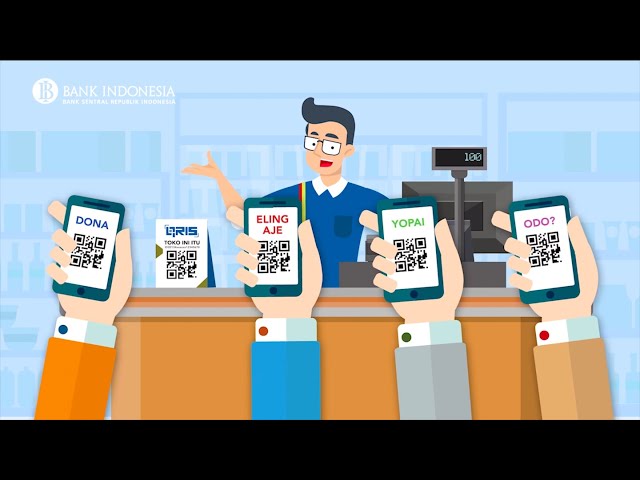
QR Code-nya Satu Untungnya Banyak!

Quick Response Code Indonesian
Standard (QRIS)

Yang Belum Pakai QRIS Wajib Nonton
Ini

[Bank Indonesia 101] - QRIS: Satu QR,
Semua Bisa Bayar
e-Wallet
Definition
A digital wallet, also known as e-wallet, refers to electronic services that
store payment instrument data, including card-based payment instruments and
electronic money, which can store funds to make payments.
e-Wallet Operators
e-Wallet Operators are payment system service
providers licensed by Bank Indonesia.
e-Wallet Restrictions
The funds contained in e-Wallets are restricted to a
total balance of Rp10 million.
Using Funds in e-Wallets
Funds contained in an e-Wallet can only be used for
the following payments:
- shopping transactions
- paying utility bills
Funds contained in an e-Wallet are non-transferable to
another e-Wallet.
Topping Up and Withdrawing e-Wallet Funds
e-Wallet funds can be topped up using cash, transfers or auto debits from
the user's bank account or electronic money. Funds can only be withdrawn by
transferring funds to the user's registered bank account or redeeming cash.
e-Wallet Regulations
Provisions regarding e-Wallets are contained within Bank Indonesia
Regulation (PBI) No. 18/40/PBI/2016 and Bank Indonesia Circular Letter No.
18/41/DKSP concerning Payment Transaction Processing.
Payment Gateway
Definition
A payment gateway is an electronic service that allows merchants to process
payment transactions using cards, electronic money and/or proprietary
channels.
Payment Gateway Providers
Payment Gateway Providers are payment system service
providers licensed by Bank Indonesia.
Payment Gateway Regulations
Provisions regarding Payment Gateways are contained within Bank Indonesia
Regulation (PBI) No. 18/40/PBI/2016 and Bank Indonesia Circular Letter No.
18/41/DKSP concerning Payment Transaction Processing.
Switching
Definition
Switching refers to infrastructure that functions as a centre and/or
provides routing services for payment transaction data through networks
using card-based payment instruments, electronic money and/or funds
transfers.
Switching Providers
Switching Providers are payment system service
providers licensed by Bank Indonesia.
Switching Regulations
Provisions regarding Switching are contained within Bank Indonesia
Regulation (PBI) No. 18/40/PBI/2016 and Bank Indonesia Circular Letter No.
18/41/DKSP concerning Payment Transaction Processing.
Proprietary Channel
Definition
A proprietary channel is a payment channel developed and owned exclusively
by a Bank for the benefit of its own customers using SMS, mobile, web,
subscriber identity module toolkit and/or unstructured supplementary service
data technologies.
Proprietary Channel Operators
Proprietary channels operated by payment system service providers in the
form of a Bank must be approved by Bank Indonesia.
Proprietary Channel Regulations
Provisions regarding Proprietary Channels are contained within Bank
Indonesia Regulation (PBI) No. 18/40/PBI/2016 and Bank Indonesia Circular
Letter No. 18/41/DKSP concerning Payment Transaction Processing.


