Overview
BI-RTGS is an electronic funds transfer system amongst participants in
rupiah with real-time settlement on an individual transaction basis. Since
becoming operational on 17th November 2000, BI-RTGS has played an important
role in processing payment transactions, including High Value Payment System
(HVPS) transactions exceeding Rp100 million as well as urgent transactions.
The second-generation BI-RTGS system became operational on 16th November
2015 with a Liquidity Saving Management (LSM) feature that aims to enhance
risk management and liquidity management efficiency.
HVPS transactions currently account for around 90% of total payment
transactions in Indonesia. Therefore, the BI-RTGS system has been designated
a Systemically Important Payment System. Since 2016, Bank Indonesia has
operated the second-generation BI-RTGS system, boasting liquidity management
and liquidity saving features to increase efficiency and enhance risk
mitigation.
BI-RTGS confers numerous benefits. In addition to greater assurance of
settlement finality for each transaction, which minimises settlement risk,
BI-RTGS is also a practical, fast, efficient, secure and reliable interbank
funds transfer system.
BI-RTGS is also complemented with a centralised account mechanism as a
reliable way to enhance fund management effectiveness for the participants
as well as the monetary and banking authority. For the authorities,
information concerning fund management in the banking industry is important
supporting information for monetary operations activities and an early
warning system in terms of bank oversight.
BI-RTGS is designed to ensure gross settlement in real-time that is final
and irrevocable. Transaction settlement in the BI-RTGS system is processed
in real-time and irrevocable. Real-time settlement is limited to outgoing
transactions from a sending bank to Bank Indonesia to be forwarded to the
recipient bank. Meanwhile, the final settlement window for customer
transfers depends on the internal conditions and system standards of each
participant, potentially leading to a discrepancy between final settlement
in the BI-RTGS system and the funds received in the customer's account.
BI-RTGS also features Gridlock Resolution. This mechanism aims to prevent
gridlock, namely when several participants cannot settle their obligations
until claims have been settled. Gridlock Resolution is an automatic feature
of BI-RTGS.
To accelerate the final settlement process of the BI-RTGS system, the
operating entity urges all participants to comply with the Throughput
Guidelines as a specific target percentage of total transactions processed
in one day. Compliance to the Throughput Guidelines reduces the possibility
of payment transactions accumulating at the end of the day. The Throughput
Guidelines are regulated based on each respective transaction zone, namely
Zone I (min 30%), Zone II (min 30%) and Zone III (max 30%).
The Intraday Liquidity Facility (FLI) and Sharia Intraday Liquidity Facility
(FLIS) are reserve liquidity facilities available to BI-RTGS participants on
an intraday basis. FLI/FLIS is available to eligible participants in order
to overcome temporary liquidity shortfalls or an intraday gap.
An intraday gap can occur because gross settlement means transactions are
settled continuously throughout the working day, requiring significant
liquidity. Eligible participants for FLI/FLIS are still required to provide
quality collateral in the form of Bank Indonesia Certificates (SBI) and
government securities (SBN) on an intraday basis. Since 1st November 2018,
Bank Indonesia has provided the intraday liquidity facility at no cost to
the participants.
The BI-RTGS system is a Settlement Processor. BI-RTGS provides a means of
final settlement for retail payments, including the National Clearing System
(SKNBI) as well as ATM/debit card/credit card clearing. In addition to
retail payments, BI-RTGS also provides a means of transferring the final
settlement and transfer of funds from securities trading, interbank forex
trading, funds settlement from monetary operations/open market operations
(OMO), government payments and securities.
To meet the highest security standards and ensure uninterrupted availability
during the operating window for the participants and operator, the BI-RTGS
system is fully equipped with procedures and contingencies to handle
disruptions and/or emergencies, including the Contingency Plan, back-up
facilities and the Business Continuity Plan (BCP). In addition, the
operating entity also provides Guest Bank and back-up facilities for
participants at Bank Indonesia in the event of disruptions and/or
emergencies in order to prevent participant default when using the RTGS
terminal to process settlements through the BI-RTGS system.
BI as the Authority
In accordance with the Bank Indonesia Act (No. 23 of 1999, No. 3 of 2004 and
No. 6 of 2009), Article 8 stipulates that one function of Bank Indonesia is
to regulate and maintain the payment system. To that end, Bank Indonesia is
authorised to licence payment system services providers, to require payment
system operators to report to Bank Indonesia and to determine the use of
payment instruments (Article 15).
Bank Indonesia's function as the payment system authority includes Regulator
and Overseer of the BI-RTGS system. As regulator, Bank Indonesia has a solid
legal foundation for BI-RTGS system implementation as well as to determine
the role and responsibilities of BI-RTGS system operators and participants.
As Overseer, Bank Indonesia ensures that BI-RTGS system administration meets
the 10 Core Principles for Systemically Important Payment Systems (CP-SIPS)
issued by the Bank for International Settlements (BIS), such as supporting
financial system stability and fulfilling consumer protection principles.
The supervision function is implemented through policymaking, consultation
meetings with operators, monitoring and assessment.
As one supervisory activity, Bank Indonesia requires operators and
participants to maintain adequate security standards. To assess the
operational security of the BI-RTGS system, Bank Indonesia may request an
independent auditor to perform a security audit, including the applications
and networks used in the BI-RTGS system, to ensure confidence that the
system is secure and reliable. In addition, Bank Indonesia also requires
operators and all participants to conduct back-up trials as well as maintain
a Disaster Recovery Plan (DRP) and Business Continuity Plan (BCP). Meeting
the requirements as a participant as well as regulatory compliance by the
RTGS system operator are key aspects of oversight, in addition to reporting
obligations concerning the participants' internal assessments.
BI as RTGS System Operator
As the RTGS system operator, Bank Indonesia has the
following responsibilities:
- Operate an efficient, fast, secure and reliable RTGS system;
- Provide clarification to the participants concerning the financial
risks associated with BI-RTGS system participation and the risk
mitigation measures required;
- Ensure regulatory compliance amongst the participants, including
submission of internal BI-RTGS audit reports by the participant.
The operator of the BI-RTGS system is required to
provide the following infrastructure and services:
- Infrastructure and facilities to operate the BI-RTGS system, including
the hardware, software, data communication network (leased line),
dial-up facilities and other supporting facilities.
- A helpdesk to assist participants overcome operational difficulties.
- Training provided to the participants.
- Maintain a Disaster Recovery Plan (DRP) and Business Continuity Plan
(BCP) and conduct periodic trials with participant involvement.
- Hold regular meetings with user groups.
Participants
BI-RTGS participants include all banks and nonbank financial institutions.
BI-RTGS participants are categorised as Direct Participants or Indirect
Participants. Direct Participants can send BI-RTGS system transactions using
their own identity, while Indirect Participants can only send BI-RTGS system
transactions using the identity of a Direct Participant.
The legal relationship between BI-RTGS participants and Bank Indonesia as
the system operator is contained within a BI-RTGS usage agreement, which
regulates the various rights, obligations and responsibilities of the
participants and the operator.
In addition to the regulations and agreements between participants and
operator as the legal foundation for the daily operation of the BI-RTGS
system, the technical aspects are regulated through a number of by-laws
agreed by participants that are not contained in prevailing BI regulations
or agreements.
When initiating a transfer instruction, BI-RTGS participants are required to
comply with Know Your Customer (KYC) Principles as well as
anti-money-laundering laws. To that end, the identities of the sender and
recipient as well as the relevant data must be completed accurately and in
full.
Service Level Agreement (SLA)
The funds must be received by the customer no more than two hours after the
transfer order has been received from the sender by the bank.
Pricing Policy
BI-RTGS System pricing policy for all participants is
as follows:
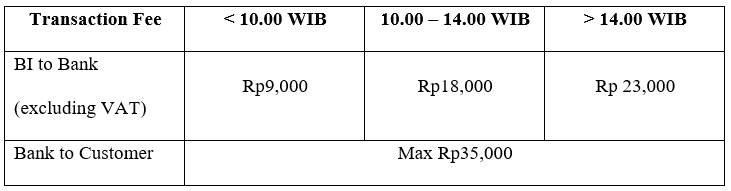
A Single Credit Transaction Fee is charged for sending a one-time
transaction and a Multiple Credit Transaction Fee is charged for sending a
bundled transaction for two or more transactions up to 10 transactions.
Sending fees are also based on the morning, midday and afternoon window
times, which encourages participants to send transactions earlier and, thus,
maintain the distribution of RTGS transactions throughout the day. In
addition to the transaction fees, Bank Indonesia also charges a fee for
sending administrative messages or using the Guest Bank facilities along
with other fees.
BI-RTGS participants can charge their customers different fees for
processing transactions through the BI-RTGS system based on the respective
policy of the bank or financial institution, including investment fees,
application maintenance, personnel fees and other fees. Nevertheless, Bank
Indonesia has capped the maximum funds transfer fee from banks to their
customers at Rp35,000.
Bank Indonesia also requires each bank to display BI-RTGS charges clearly,
including Bank Indonesia's charges for the participants and the
participants' charges for their customers.
Window Time
RTGS System Operational Schedule (GMT+7)
| 1 |
System Open |
06:30 |
| 2 |
Funds Transfer and Regular Credit Services |
|
|
a. 1st Settlement Window
|
06:30 - 11:00 |
|
b. 2nd Settlement Window |
06:30 - 16:30 |
|
c. 3rd Settlement Window |
06:30 - 16:30 |
|
d. 4th Settlement Window |
06:30 - 17:00 |
|
e. 5th Settlement Window |
11:00 - 16:30 |
|
f. 6th Settlement Window |
06:30 - 17:00 |
|
g. 7th Settlement Window |
18:00 - 19:00 |
|
h. 8th Settlement Window |
06:30 - 16:30 |
|
i. 9th Settlement Window |
|
| 3 |
Paper-based debit clearing services |
17:00 |
|
a. Zone I
|
|
|
b. Zone II
|
|
|
c. Zone III
|
|
| d. Zone IV
|
|
|---|
| 4 |
Regular Debit Services |
|
|
Settlement |
16:00 |
| 5 |
System Cut-Off |
16:45 |
Oversight
The Bank Indonesia – Real Time Gross Settlement (BI-RTGS) System is an
infrastructure for processing high-value transactions and is connected to
other primary financial system infrastructures. Therefore, the BI-RTGS
System poses systemic risk to Indonesia's financial system and, therefore,
the security and seamless continuity must be maintained constantly through
effective oversight, amongst others.
Bank Indonesia has discharged its BI-RTGS oversight function since 2002. The
aim of this oversight function is to ensure an efficient, fast, convenient,
affordable, secure and reliable system, while ensuring inclusive access and
consumer protection based on international standards and best practices.
Implementation and oversight of the BI-RTGS system as systemic financial
market infrastructure are executed based on the international standard, the
Principles for Financial Market Infrastructures (PFMI) issued by CPSS-IOSCO.
Furthermore, Bank Indonesia has adopted the PFMI in the operation of the
BI-RTGS System in the form of
Principles for Bank Indonesia-Operated Payment System as Part of Financial
Market Infrastructures.
In addition, Bank Indonesia has published
Disclosure Framework of BI-RTGS System in order to provide comprehensive
disclosure as a form of transparency concerning the governance, operational
activity and risk management framework of the BI-RTGS system, including
level of compliance with the PFMI.
Other Information:
-
BI Payment System Helpdesk
Phone: +62212981-8888
-
Ministry of State Secretariat
JL.Veteran No 17-18 Jakarta 10110
Tel. (021)3845627, 3442327
Website: www.setneg.go.id


